
How to Stop Forgetting Your HRT: A Tracking System That Works
How to Stop Forgetting Your HRT: A Tracking System That Works Here is the part nobody warns you about. It is not just remembering to take hormone therapy. It is remembering which patch day it is,…
How to Stop Forgetting Your HRT: A Tracking System That Works
Here is the part nobody warns you about. It is not just remembering to take hormone therapy. It is remembering which patch day it is, whether you already put the gel on this morning, when you last changed the patch, and which bit of skin the last one went on so you don't reuse the same spot. That is four or five small decisions riding on top of a day that already has enough in it.
Most of the time people don't forget through negligence. They forget because the routine asks your mind to keep several separate rhythms going at once, without a single daily anchor to hang them on. It's a systems problem and it has a systems solution, which is one you can put in place today: a reliable cue, an easily viewed log, and a straightforward map of where those patches are located.
Why HRT is uniquely easy to forget
Different forms run on different clocks. A gel is smoothed on once a day, a tablet is usually once a day, and a patch changes every few days rather than daily, as the NHS overview of HRT patches, gels, and sprays lays out. Each one wants a different habit, and your regimen might combine two of them.
The twice-weekly patch is the sneaky one. It is not daily, so there is no automatic "every morning" slot to attach it to, and the change day quietly drifts until you genuinely cannot remember if today is the day or if you already did it Tuesday.
Then there is the second memory task stacked on the first: which site did I use last? By the time three or four days have passed, that detail is long gone. This friction between the treatment and ordinary forgetful human days is exactly why we built Rosel, and it is the thing a good system is built to absorb.
Why staying consistent is worth a small system
Keep the promise here modest, because this matters. Hormone therapy is individualized between you and your clinician, and The Menopause Society describes a period of trial and error to land on the right dose and regimen. The point of a tracking habit is simply that the plan you already agreed on actually happens the way it was written.
Worth saying plainly. A tracker just keeps the record: what you took, when, laid out so nothing slips. It won't read your symptoms and hand back a diagnosis, it won't treat anything, and it is no stand-in for the licensed provider who sets your dose. Those calls stay between you and your doctor.
So this is not a promise about symptoms or outcomes. It is a much smaller, more honest goal: fewer missed doses, fewer "wait, did I?" moments, and a clearer picture to bring to your next appointment.
Step 1: Attach the reminder to something you already do
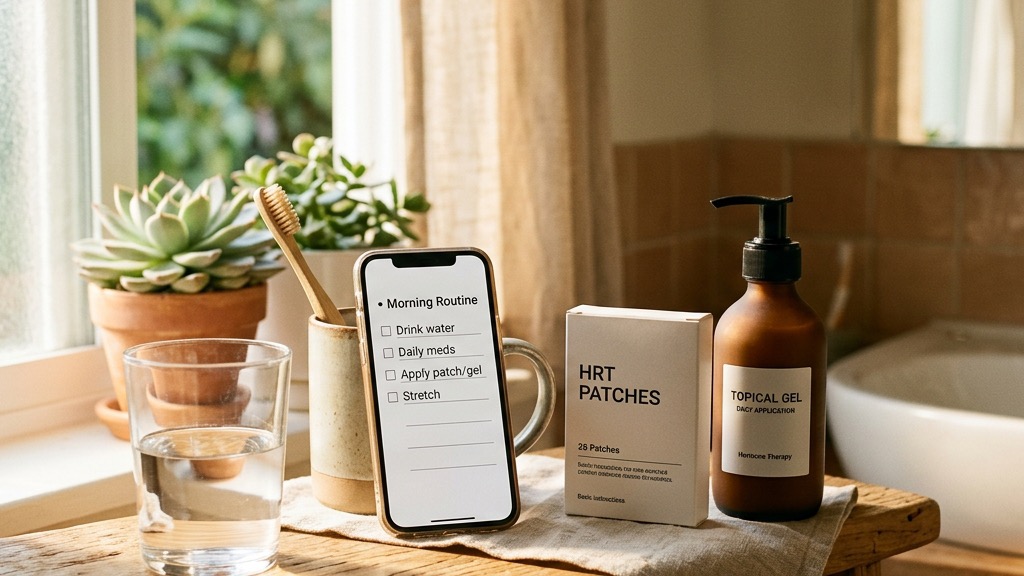
A cue tied to an existing habit beats a floating alarm you learn to swipe away. For a daily gel or pill, hook it to something you never skip: brushing your teeth, the first coffee, feeding the cat. The medication rides along on a routine that is already automatic.
For a twice-weekly patch, pick two fixed days and never move them. Monday and Thursday, say, every single week. The NHS suggests changing on the same day each week for exactly this reason, so the schedule stops being a moving target you have to recalculate.
A repeating phone reminder is a fine backstop. But the physical anchor, the toothbrush or the coffee, is what actually survives a chaotic morning, because it does not depend on you noticing a notification at the right second.
Step 2: Keep a log you can actually see
The log exists to answer one question without making you reconstruct your morning: did I already take it? A checkbox you can glance at settles the "I think I did but I'm not sure" spiral in a second, which is where a lot of accidental double-doses and skips come from.
Plenty of things work for this. A sticky note on the bathroom mirror with the week's days. A habit-tracker app with a single daily tick. The only real requirement is that one look tells you today is done or not done, and a gap is obvious rather than hidden.
This is the job an HRT tracker built for this is meant to do: log the patch, pill, or gel, show the day's progress at a glance, and keep a dated history so a forgotten dose stands out instead of disappearing. It records what happened. It does not change your plan, and later that same log becomes the honest summary you hand your doctor instead of relying on memory in a ten-minute appointment.
Step 3: Map your patch sites so you stop guessing
Rotation is not fussiness, it is skin care. Mayo Clinic's instructions for estradiol patches are to apply each new patch to a different area of the lower abdomen and to wait at least a week before reusing the same spot, while avoiding the waistline and the breasts. Reusing one patch of skin too soon is how irritation creeps in.
The trouble is that "a different area than last time" only works if you remember last time, and by day four you usually don't. That is a memory problem, so give it a memory aid instead of willpower.
On paper, it can be as plain as two columns, left and right, with an upper and lower row, and a tick in the box each time you change. In the tracker, a small body map marks where the last patches went, so the next site is a glance and not a guess. Either way, the rotation stops living in your head.
What to do when you miss one anyway
You will miss one eventually, and the fix is not to panic or double up. The NHS guidance on a missed patch or dose says to change a forgotten patch as soon as you remember, and if it is nearly time for the next one, skip the missed one and change on your usual day. For a missed daily dose, take it unless the next one is close, then skip it rather than taking two.
A visible log helps here in a quiet way. When you are staring at the packet unsure whether you missed it or just don't remember, the log tells you which, so you are acting on a fact instead of a guess.
Which brings up the honest part. A tracker can nudge you and show you the gap. What it can't do is work out the right fix for your particular regimen. So when you're not sure, go by the product leaflet and your clinician. Not the app.
The goal is fewer decisions, not more
The whole system comes down to three moving parts. A cue that borrows a habit you already have, a log you can see in one glance, and a map that remembers your patch sites for you. None of it is clever. It just moves the remembering out of your head and onto something reliable.
That is the real relief. HRT and menopause already ask a lot of you, and the tracking part does not need to be one more thing you carry around all day.
If you would rather not run this on paper, Rosel on the App Store keeps the log, the reminders, and the patch map in one place. Your health data stays on your phone or in your private iCloud, nothing sold and nothing stored on a server, which for something this personal is the way it should be.