
Night Sweats vs Hot Flashes: What's the Difference?
Night sweats and hot flashes are the same vasomotor event, one just happens while you sleep. Why the timing changes everything, and when a night sweat isn't menopause.
Night Sweats vs Hot Flashes: What's the Difference?
Here is the thing most people are not told: night sweats and hot flashes are the same event. The Menopause Society puts it plainly, that night sweats are hot flashes that occur during sleep. Same wave of heat, same underlying mechanism, just a different time of day. So the honest answer to "what's the difference" is mostly about when they hit you. Which sounds like a technicality, right up until you notice that the timing changes almost everything about what they cost you.
Both go by the clinical name vasomotor symptoms, and whether you lump them together or split them apart matters for practical reasons rather than medical ones. A daytime flash is an annoyance you ride out. A night sweat is a thief, because it steals your sleep, and the lost sleep is usually what drags the rest of your days down. So the distinction worth drawing is not about biology. It is about impact, about tracking, and about knowing when a night sweat might not be menopause at all.
They really are the same event
It is worth sitting with the reassuring version of this first. A night sweat is not a separate condition that has arrived on top of your hot flashes. It is the identical vasomotor event, the flush and the heat and the sweating, happening while you are asleep instead of while you are awake. The Menopause Society groups hot flashes and night sweats together as vasomotor symptoms for exactly that reason.
So if you get flashes by day and sweats by night, that is one thing expressing itself around the clock, not two problems ganging up on you. Naming it as a single event takes a bit of the menace out of it.
What each one actually feels like
The daytime version usually announces itself as a sudden wave of heat that climbs through your chest, neck, and face, often with flushing and a burst of sweat, and it tends to pass within a few minutes. You learn its signature quickly: the prickle, the urge to peel off a layer, the pull toward an open window.
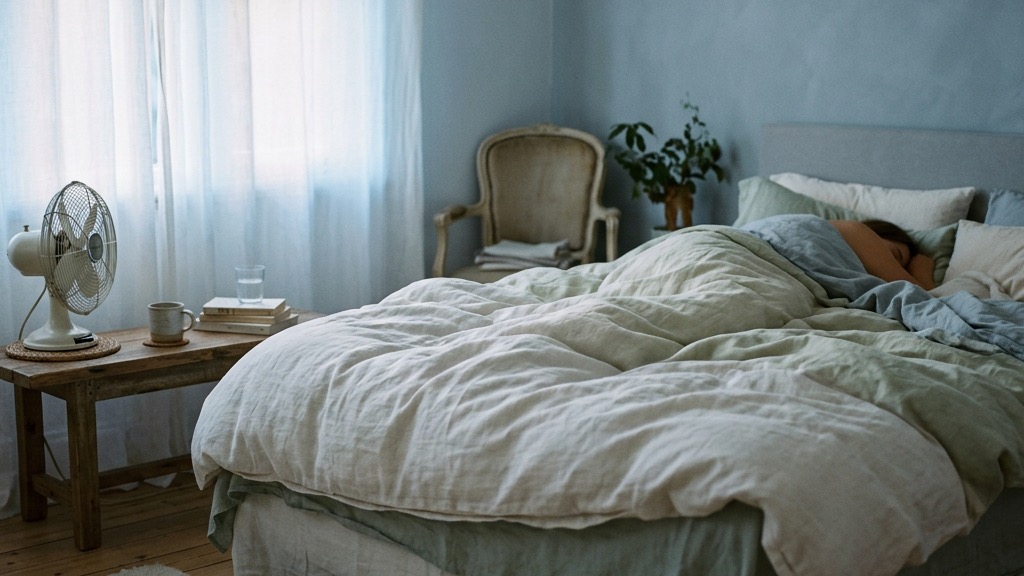
The night version is the very same wave, but you are asleep when it begins, so you tend to surface already hot and already damp, kicking off the covers. Then comes the clammy, chilled aftermath as the sweat cools on your skin, and the wide-awake stretch where sleep simply will not come back. Same event, experienced from inside sleep, which is exactly what makes it so much more disruptive.
So why does the difference matter?
Because timing changes the cost of it completely. A flash at your desk is a couple of sticky minutes, gone before long. A flash at 3 a.m. is a different animal. It wakes you. It soaks the bed. It rips your sleep in two, and that torn sleep is what shows up tomorrow as bone-tiredness, a snappish mood, a head full of fog. Ounce for ounce the night version costs you far more, and that is the case for treating it as its own problem, even though what is happening in your body is the exact same thing. The sleep it steals is usually where the real harm sits, which is why it helps to know what actually wrecks menopause sleep and how to track it.
Why it pays to track them separately
Even though they are the same event, log them in separate columns. Your daytime count tells you about frequency and triggers, the wine or the warm room or the stressful meeting. Your night count tells you something more specific and more useful: why your sleep is in pieces. Keeping them apart is how you work out which version is actually driving your worst days.
The method is the same one you would use for the daytime kind, just split by clock. If you want the full approach to counting them and spotting what sets them off, I broke it down in a guide to tracking hot flashes and reading the pattern, and everything in it applies to the night ones too.
A concrete payoff: after a couple of weeks you might see your daytime flashes holding steady at a manageable four or five, while the night ones bunch up on the evenings you had a glass of wine. That splits one blurry complaint into two clear ones, a daytime pattern you can mostly live with, and a nighttime trigger you can actually do something about.
When a night sweat might not be menopause
Here is the one place the "versus" genuinely matters medically, and it is worth reading carefully. Night sweats have plenty of causes that have nothing to do with menopause, and some of them are worth ruling out. Cleveland Clinic lists infections like the flu, an overactive thyroid, diabetes, sleep apnea, anxiety, alcohol, a number of medications, and, less commonly, cancers such as leukemia and lymphoma among the things that can drench you at night.
None of that is cause to panic, but it is cause not to assume. Night sweats that soak you with no daytime flashes at all, or ones that turn up with a fever, weight you did not mean to lose, or other new symptoms, deserve a proper look rather than a shrug. The guidance is to see a provider if night sweats are breaking up your sleep, and to keep in mind that only a provider can actually pin down the cause. Around midlife, menopause is the likely answer. It just is not the automatic one.
A rough rule of thumb helps here. Night sweats that travel alongside daytime flashes, in a woman in her forties or fifties whose periods are changing, are very likely part of the same menopausal picture. Night sweats that turn up alone, or with other unexplained symptoms like fever or weight loss, are the ones worth raising with a doctor sooner rather than later.
What helps, since it is one event
Because they are the same underlying thing, the everyday levers overlap. A cooler bedroom and breathable layers, and easing off the usual triggers like alcohol, caffeine, and spicy food close to bedtime, can take the edge off the night version just as they can the daytime one. And for troublesome vasomotor symptoms more broadly, HRT is an effective option that the Menopause Society recognizes, which is a conversation to have with a clinician rather than a decision to reach alone.
Track the pattern, let a professional read it
Tracking is the thing that drags all this out of vague misery and into something specific. Log your flashes and sweats by day and by night and you start to see the shape of it: how often, at what hours, and what tends to spark it. What it will not do is diagnose you, which matters most for the night sweats that could be something other than menopause. Gathering the pattern is your job. Confirming the cause is a clinician's.
Rosel logs the daytime flashes and the night sweats as the separate-but-related things they are, and lines them up against your sleep so the connections show. Rosel on the App Store keeps the logging quick, and your health data stays on your phone or your private iCloud, never sold and never stored on a server. Same event, very different cost. Tracking them apart is how you tell which one to take to a doctor.