
HRT Patches vs Gel vs Tablets: How to Choose
A patch, a gel, a spray, and a tablet can all deliver estrogen. Here is how the main forms compare, the one real difference in blood clot risk, and how to choose the one you will actually use.
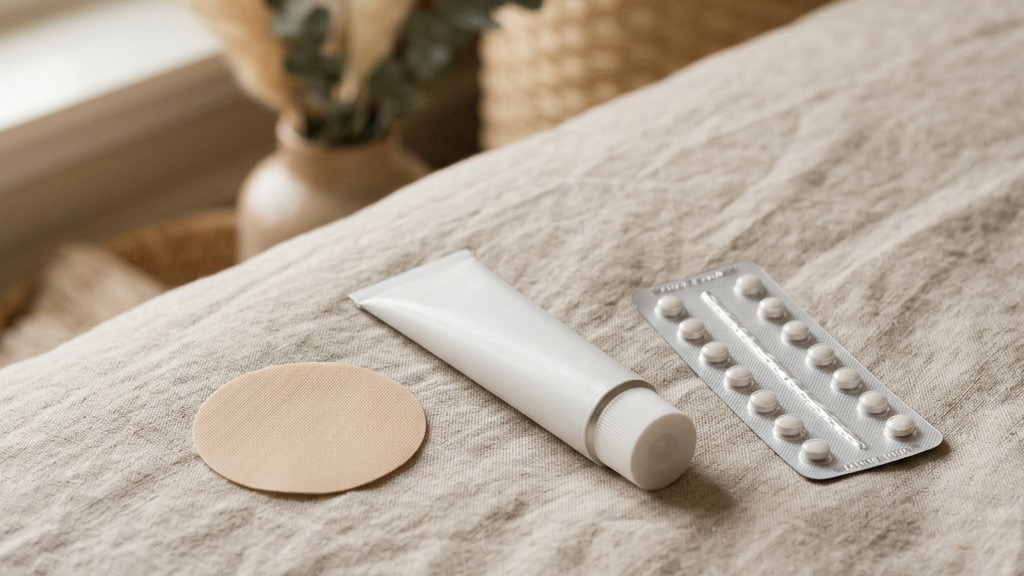
HRT Patches vs Gel vs Tablets: How to Choose
There is no single best form of HRT. Patches, gels, sprays, tablets: they can all get estrogen into your system. Which one is right for you comes down to your skin, your memory, and what your days actually look like. So the real answer to "which should I pick" is a bit unsatisfying but true. It is whichever one you will keep using, sorted out with your doctor.
One difference between them is genuinely medical rather than a matter of taste, and it is worth understanding before your appointment. The rest come down to convenience and habit. Here is how the three main forms line up, and what should really tip the decision.
How the forms differ at a glance
The NHS overview of HRT types describes each form and how it is taken. This table sums up the practical differences.
| Form | How you use it | How often | Blood clot risk |
|---|---|---|---|
| Skin patch | Sticks to the skin on the lower part of your body and releases hormone slowly | Changed every few days | Does not increase it, per the NHS |
| Gel or spray | Smoothed onto the skin, or sprayed on the inner arm or thigh | Once a day | Does not increase it, per the NHS |
| Tablet | Swallowed | Usually once a day | Higher than the skin forms, though the overall risk stays small |
That last column is the one real medical distinction, and I will come back to it. Everything else on the list is about what you will keep up with.
What should actually tip your choice
For most people the decision is not clinical, it is behavioral. Which of these are you honestly going to do without resenting it?
How well you remember. A tablet and a gel both want a slot every single day. A patch asks for attention only every few days, which is why the NHS notes a patch may be a better option than tablets if you have difficulty swallowing them, or are likely to forget. If daily is your weak spot, the twice-weekly rhythm of a patch removes six chances to slip each week. Whatever you choose, the failure point is almost never the medicine, it is the forgetting, which is the whole reason a simple system for keeping your HRT on schedule matters more than the format.
Your skin. Adhesive does not agree with everyone. Patches can leave a mark or itch, and they need a fresh site each time. Gel and spray skip the adhesive entirely, but they ask you to wait while they dry: the NHS says gel can take 5 minutes or more to dry before you dress. If glue irritates you, a skin gel may be kinder. If a daily drying wait annoys you, the patch wins.
Your day to day. Swim often, live somewhere hot, share a lot of skin contact with a small child? Patches can lift in heat and water, and gel or spray needs the area left alone until it dries and you should not let a child touch freshly treated skin. None of this rules anything out. It just decides what will annoy you least, and the form you find least annoying is the one you will still be using in six months.
The one difference that is medical, not preference
Tablets pass through your stomach and liver before the hormone reaches your blood. The skin forms absorb straight through the skin and skip that first pass. That routing is why the risk profile differs. The NHS puts it plainly: some of the risks of HRT, such as blood clots, are higher with tablets than with patches, gel, or spray, although the overall risk is still small, and it says of patches that, unlike tablets, they do not increase your risk of blood clots.
This is a well-established difference, not a fringe one, which is why the route of delivery, absorbed through the skin or swallowed as a pill, is a standard part of the conversation when clot risk is on the table. It is exactly the kind of thing to raise with your clinician rather than settle alone, especially if you have any personal or family history of clots. It can be the reason a doctor steers you toward a patch or gel over a tablet. That is their call to make with your full history in front of them, not a choice to read off a table on a blog.
What the form will not decide for you
Choosing patch, gel, or tablet is just one line on the prescription. It says nothing about your dose. It does not settle whether you also need a progestogen to protect the womb lining, which most people with a uterus do. Those parts are medical, and they tend to get tweaked over time. The Menopause Society is upfront that finding the right hormone therapy takes a period of trial and error before the dose and regimen click into place.
So hold the format loosely. Whether HRT suits you at all, at what dose, in what combination, that is a conversation for a licensed provider. An article like this one, or a tracking app, can get you ready for it. Neither can diagnose you or set your dose, and neither replaces the person who actually writes the prescription.
Take the question to your appointment
The good version of this decision happens out loud, with a clinician, framed as a joint choice. ACOG frames hormone therapy as an individual decision weighed against your own risks and benefits. Bring the practical stuff: whether you struggle with daily habits, whether adhesive bothers your skin, any history of clots in you or your family. If you want a structure for the visit, I wrote a separate guide on what to bring to a menopause appointment so the short slot goes further.
You are not locked into your first choice
Here is what takes the pressure off: the first form you try is almost never the last. Say a patch leaves your skin red, or the daily gel just never becomes a habit you keep. That is not a failure. That is something concrete to tell your clinician at the next review. People switch between patches, gels, and tablets all the time on the way to a setup that fits. You are picking a starting point here, not signing anything binding.
That is also why a clear record of how a form actually went, whether you kept up with it, whether your skin reacted, whether your symptoms shifted, is worth more than a vague memory when you sit back down with your clinician. The point of the first choice is to learn something you can act on at the next appointment.
The part that comes after you choose
Whichever form you land on, the same quiet problem shows up a week later: did I already do it today, and when is the patch due to change. That is not a chemistry problem, it is a memory one, and it is where most regimens actually wobble. Rosel logs a patch, gel, or tablet with a tap and shows the day's dose at a glance, so a missed one stands out instead of hiding. It tracks and organizes. It does not choose your form, set your dose, or stand in for your doctor.
The best form of HRT really is the one you will use without a fight. Sort out the medical questions with your clinician, then let the daily tracking run quietly in the background. Rosel on the App Store keeps the log and the patch schedule in one place, and your health data stays on your phone or your private iCloud, never sold and never stored on a server.